
The journey from Marrakech’s bustling medinas to the magnificent Erg Chebbi dunes of Merzouga ranks among North Africa’s most transformative travel experiences. This 3 days tour from Marrakech to Merzouga Desert adventure compresses Morocco’s incredible diversity into a meticulously crafted itinerary, traversing the High Atlas Mountains, ancient kasbahs, dramatic gorges, and culminating in the Sahara Desert’s towering golden dunes. For travelers seeking authentic Moroccan experiences beyond typical tourist circuits, this expedition delivers unforgettable encounters with landscapes, cultures, and traditions that have remained largely unchanged for centuries.
Day One: Crossing the High Atlas and Entering Desert Frontiers
The adventure begins early in Marrakech, where travelers depart the Red City as dawn breaks over the Koutoubia Mosque’s minaret. The route immediately climbs toward the High Atlas Mountains via the Tizi n’Tichka Pass, Morocco’s highest road crossing at 2,260 meters elevation. This engineering marvel snakes through mountain landscapes of breathtaking beauty, where Berber villages cling to impossibly steep slopes and terraced agriculture demonstrates centuries of mountain farming expertise.
The ascent reveals dramatic elevation transitions from Marrakech’s arid plains through green valleys where walnut and cherry trees flourish, eventually reaching alpine environments where snow caps peak even during summer months. Roadside stops provide opportunities to purchase traditional Berber crafts directly from artisans, including hand-woven carpets, argan oil products, and distinctive pottery reflecting regional aesthetic traditions.
Descending the pass’s southern slopes, the landscape transforms dramatically. Vegetation becomes sparse, rock formations take on reddish hues, and the air carries desert warmth replacing mountain coolness. The fortified village of Aït Benhaddou appears like a mirage, an UNESCO World Heritage Site where earthen architecture cascades down hillsides in harmonious geometric patterns. This remarkably preserved ksar (fortified village) has served as backdrop for numerous films including “Gladiator,” “Lawrence of Arabia,” and “Game of Thrones,” though its authentic historical significance far exceeds Hollywood fame.
Walking through Aït Benhaddou’s narrow passages transports visitors centuries backward. Local families still inhabit portions of this ancient settlement, maintaining traditional lifestyles within structures built using pisé (rammed earth) construction techniques perfected over generations. The intricate decorative elements, geometric patterns, carved wooden details, and strategic window placements optimizing natural cooling demonstrate sophisticated architectural understanding adapted to harsh environmental conditions.
Continuing through Ouarzazate, often called Morocco’s “Hollywood,” the route follows the Valley of Roses toward Dades Valley. This region explodes with pink Persian roses during April and May, when locals harvest blossoms for processing into rose water and essential oils exported worldwide. The Dades Gorge presents spectacular geological formations where the river has carved deep canyons through limestone and marl, creating walls rising hundreds of meters above narrow riverbeds.
The first day concludes in a traditional hotel or guesthouse perched along the gorge rim, where sunset transforms rock formations into ever-changing palettes of amber, crimson, and purple. Evening meals feature authentic Moroccan cuisine tagines slow-cooked in earthenware pots, couscous heaped with vegetables and tender meat, and mint tea served with ceremonial precision.
Day Two: Through Gorges to the Desert’s Edge
Morning light reveals Dades Gorge’s full majesty as the journey continues toward Todra Gorge, arguably Morocco’s most dramatic canyon. The gorge narrows to a bottleneck where sheer limestone cliffs rise 300 meters on both sides, separated by merely 10 meters at the narrowest point. This natural cathedral creates microclimates where temperatures plummet even during scorching summer days, while a permanent river sustains lush palm groves contrasting starkly with surrounding aridity.
Rock climbers from around the world tackle Todra’s challenging routes, while casual visitors wade through shallow river sections or simply absorb the gorge’s overwhelming scale and beauty. Local Berber families operate small cafés serving refreshments to travelers who pause here before continuing toward the desert.
Departing Todra, the route crosses increasingly arid terrain through towns like Tinjdad and Erfoud, where fossil workshops display ancient marine life preserved in local limestone. These remnants prove that regions now characterized by sand and stone once lay beneath prehistoric oceans, adding geological perspective to the desert’s formation story.
Erfoud marks the transition from rocky desert to sandy erg formations. Date palm oases become more frequent, providing vital resources for communities maintaining agricultural traditions in challenging environments. The annual Date Festival celebrates harvests from these resilient trees that tolerate extreme heat and saline water while producing nutritious fruit.
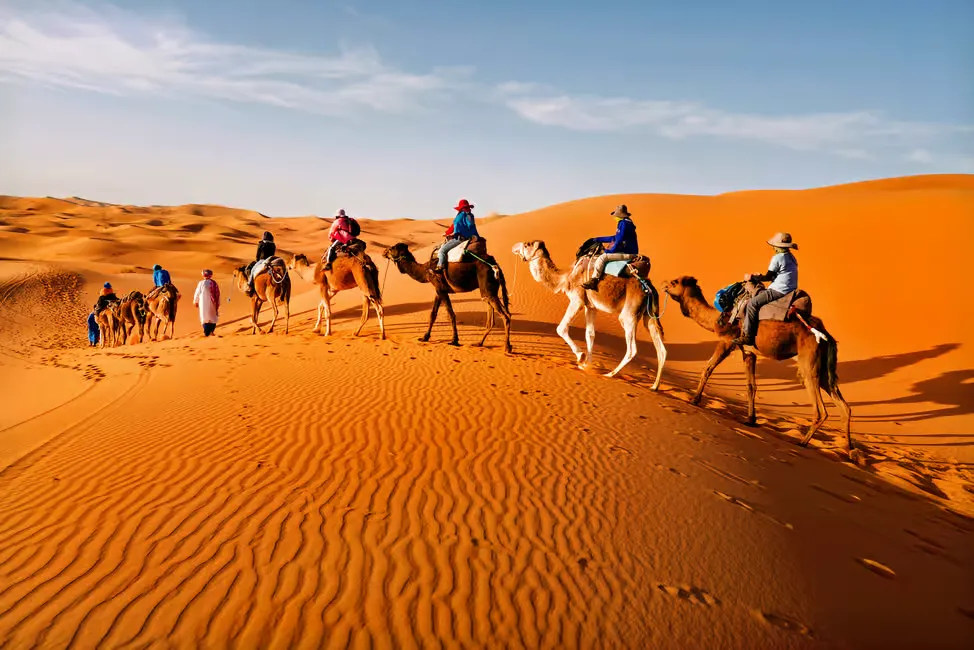
The first glimpses of Erg Chebbi’s massive dunes inspire awe golden sand mountains rising over 150 meters create horizons of pure geometric beauty. Arriving at desert camps positioned at the dunes’ edge, travelers typically transfer to camels for sunset excursions into the sand sea. Swaying atop these “ships of the desert,” watching the sun paint dunes in constantly shifting colors, ranks among travel’s transcendent experiences.
Desert camps range from basic Berber-style tents to luxury accommodations featuring comfortable beds, private bathrooms, and gourmet dining. Regardless of amenity levels, evenings follow similar patterns: traditional dinners around campfires, Berber music performances featuring drums and traditional songs, and extraordinary stargazing under skies unpolluted by artificial light. The Milky Way appears as a luminous river, while meteor showers and satellite passages provide celestial entertainment impossible to witness in urban environments.
Day Three: Desert Dawn and Return Journey
Experiencing Saharan sunrise justifies the pre-dawn wake-up call. As darkness gradually yields to light, dunes transform through subtle color progressions deep purples giving way to roses, ambers, and finally brilliant golds as sunlight crests the horizon. The temperature differential between night cold and emerging warmth creates otherworldly atmospheric conditions where sound carries unnaturally and distance becomes difficult to judge.
Post-sunrise options vary by tour operator and personal preference. Some itineraries include sandboarding down steep dune faces, four-wheel-drive excursions to nomadic settlements, or visits to Khamlia village where Gnawa musicians descendants of sub-Saharan peoples perform hypnotic traditional music blending African rhythms with Berber and Arabic influences.
The return to Marrakech typically follows the Ziz Valley, an extraordinary 20-kilometer palm oasis creating a green ribbon through an otherwise barren landscape. This ancient river route sustained trans-Saharan trade caravans for centuries, and fortified ksour (plural of ksar) dotting the valley demonstrate its strategic importance throughout history.
Passing again through Midelt, positioned between High and Middle Atlas ranges, travelers may stop at apple orchards and mineral shops before tackling the return crossing of Tizi n’Tichka. The route covers over 560 kilometers each direction, and while modern roads make this journey feasible in three days, the pace remains demanding but richly rewarding.
Practical Considerations for Maximum Enjoyment
Successful three-day Merzouga tours require thoughtful preparation. Packing essentials include layers for dramatic temperature variations; desert nights can drop below freezing even when daytime temperatures exceed 100°F (38°C). Sun protection high-SPF sunscreen, sunglasses, and head coverings proves critical in environments where UV exposure intensifies through altitude and desert reflection.
Comfortable footwear matters significantly. Closed-toe shoes protect feet during ksar exploration and prevent sand burns during dune walking, though sandals provide relief during long drives. Small backpacks should contain water bottles, snacks, medications, and camera equipment, as access to supplies becomes limited outside major towns.
Timing significantly impacts experience quality. Spring (March-May) and autumn (September-November) offer ideal weather conditions with moderate temperatures and occasional wildflower blooms transforming normally barren landscapes. Summer (June-August) brings extreme heat making midday activities uncomfortable, though dawn and dusk remain spectacular. Winter (December-February) provides comfortable daytime temperatures but requires serious cold-weather gear for desert nights.
Photography opportunities abound throughout the journey. Wide-angle lenses capture expansive landscapes, while telephoto options help photograph distant kasbahs and wildlife. Drone photography faces restrictions in certain areas, requiring advance research regarding regulations. The constantly changing light conditions reward photographers who understand golden hour timing and shadow composition.
Cultural Sensitivity and Authentic Engagement
Interacting respectfully with local Berber communities enriches the experience immeasurably. Morocco’s indigenous Berber populations maintain distinct languages, customs, and traditions despite centuries of Arab influence. Learning basic Berber phrases “azul” (hello), “tanemmirt” (thank you) demonstrates respect and typically elicits warm responses.
Photography etiquette requires asking permission before photographing people, particularly women and children. Many locals welcome photos but appreciate being asked, and some may request small tips. Commercial transactions whether purchasing crafts or services involve expected negotiation, though maintaining friendliness throughout haggling processes ensures positive interactions.
Conclusion
The 3 days tour from Marrakech to Merzouga Desert distills Morocco’s essence into an intensive, transformative journey. From High Atlas peaks to Saharan dunes, ancient kasbahs to palm oases, this expedition reveals landscapes of staggering diversity and beauty. The experience transcends typical tourism, offering genuine encounters with cultures, environments, and traditions that have endured for millennia. While the pace remains demanding and accommodations vary from basic to luxurious depending on tour selection, the memories forged during this desert pilgrimage create lasting impressions that redefine travelers’ understanding of Morocco’s extraordinary character.
Key Takeaways
Route Diversity: The journey encompasses incredible geographical variety High Atlas mountains, UNESCO heritage sites, dramatic gorges, palm valleys, and finally the Sahara’s majestic dunes, showcasing Morocco’s compressed natural diversity.
Cultural Immersion: Authentic interactions with Berber communities, traditional music performances, and stays in desert camps provide genuine cultural experiences beyond superficial tourist encounters.
Optimal Timing: Spring and autumn offer ideal conditions with moderate temperatures and spectacular light, while summer brings extreme heat and winter requires substantial cold-weather preparation for desert nights.
Photography Paradise: Constantly changing landscapes, dramatic lighting conditions, and architectural treasures create unlimited photography opportunities requiring proper equipment and timing awareness.
Preparation Essentials: Success requires thoughtful packing including temperature-appropriate layers, sun protection, comfortable footwear, and realistic expectations about the journey’s demanding pace across challenging terrain.
